
 AR
AR  EN
EN  ES
ES  PT
PT  VI
VI  FR
FR  DE
DE  IT
IT  JA
JA  KO
KO  PL
PL  TR
TR  BG
BG  MS
MS  RU
RU 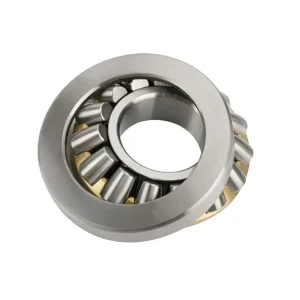
Abstract
A thrust bearing is a specialized mechanical component engineered to manage axial loads, which are forces exerted parallel to the axis of a rotating shaft. Its primary function is to facilitate rotation between parts while supporting a significant thrust force. The operational principle hinges on transferring the axial load through rolling elements—such as balls or rollers—that are situated between two washer-like raceways. One raceway is typically fixed to a stationary housing, while the other rotates with the shaft. This arrangement allows the rolling elements to bear the load, converting high-friction sliding motion into low-friction rolling motion. Different designs, including ball thrust, cylindrical roller, tapered roller, and spherical roller thrust bearings, are optimized for varying conditions of load magnitude, speed, and potential misalignment. The selection of a specific type depends on the application's unique demands, from automotive transmissions to heavy industrial machinery and marine propulsion systems, highlighting their integral role in modern engineering.
Key Takeaways
- Thrust bearings manage forces that are parallel to the shaft's axis.
- They convert sliding friction into low-friction rolling motion.
- The core components are two raceways, rolling elements, and a cage.
- Understanding how does a thrust bearing work is key to proper selection.
- Choose a ball type for speed and a roller type for heavy loads.
- Proper lubrication is essential for bearing longevity and performance.
- Misalignment can be accommodated by spherical roller thrust bearings.
Table of Contents
- An Introduction to Mechanical Forces and the Need for Thrust Bearings
- The Fundamental Mechanics: Deconstructing How a Thrust Bearing Works
- A Classification of Thrust Bearings: Selecting the Right Tool for the Job
- The Broader Context: How Thrust Bearings Integrate with Other Systems
- Thrust Bearings in Action: Case Studies from Global Industries
- Ensuring Peak Performance: A Guide to Selection, Installation, and Maintenance
- Frequently Asked Questions (FAQ)
- Final Reflections
- References
An Introduction to Mechanical Forces and the Need for Thrust Bearings
To truly grasp the significance of a device like a thrust bearing, one must first step back and consider the world of unseen forces that govern every machine with a rotating part. Imagine a simple spinning top. The forces that keep it upright and spinning on its point are primarily radial—acting outwards from its center of rotation. Now, imagine pressing your finger down on the top of that spinning top. That downward force, acting along the axis of its spin, is an axial force, or thrust. In the world of machinery, from the car you drive to the massive turbines that generate electricity, these axial forces are ever-present and, if left unmanaged, deeply destructive. This is the fundamental problem that the thrust bearing was conceived to solve.
Axial vs. Radial Loads: A Tale of Two Forces
In mechanical engineering, loads are not monolithic; they possess direction and character. A radial load acts perpendicularly to the shaft's central axis, much like the weight of a belt on a pulley. It seeks to push the shaft sideways. Most common bearings, like the standard ball bearings you might find in a skateboard wheel, are designed primarily to handle these radial loads. They provide a smooth path for rotation while supporting this sideways force.
An axial load, or thrust load, is entirely different in its nature. It acts parallel to the shaft's axis, attempting to push the shaft lengthwise. Think of the force exerted by a propeller on a ship's drive shaft, pushing the vessel forward. Or consider the immense downward pressure on the drill string of an oil rig as it bores into the earth. These are not sideways forces; they are direct, end-on pressures. A standard radial bearing is ill-equipped to handle such a force. Subjected to a significant axial load, its internal components would be pushed together in a way they were not designed for, leading to intense friction, rapid wear, and catastrophic failure. The question of how does a thrust bearing work is fundamentally a question of how to manage this specific, directional force.
The Inevitable Problem of Friction and Wear
Without a bearing specifically designed for thrust, two surfaces pushing against each other while one rotates would generate an immense amount of sliding friction. Let us personify this interaction for a moment. The rotating component grinds against the stationary one, not with a smooth, rolling grace, but with a brutish, scraping aggression. This friction does two things, both of them detrimental. First, it generates heat—a lot of it. This heat can alter the material properties of the metal components, causing them to soften, warp, or even weld together. Second, it causes wear. Microscopic particles are torn from the surfaces, a process known as abrasion. Over time, this material loss compromises the integrity of the components, leading to a loss of precision, increased vibration, and eventual breakdown. The machine loses efficiency as energy is wasted in the form of heat, and its operational life is drastically shortened. This is the scenario that engineers must prevent.
A Historical Perspective: The Evolution of Managing Thrust
The concept of reducing friction is ancient. One can imagine early humans discovering that rolling a heavy object on logs was far easier than dragging it. This is the nascent idea of a rolling element bearing. Historical accounts suggest the Egyptians may have used such methods to move the massive stones for the pyramids. Yet, the formal conceptualization of a bearing to handle thrust came much later. Leonardo da Vinci, in his famous notebooks from around the year 1500, sketched a design for a device that used captive balls to reduce friction in a rotating platform. His design was, in essence, a primitive thrust bearing. He understood that allowing the load to be carried by rolling elements rather than sliding surfaces was the key.
However, it was the Industrial Revolution that created the urgent, large-scale need for reliable thrust bearings. As steam engines, turbines, and powerful new machines were developed, the axial forces they generated grew exponentially. Early solutions were often crude "thrust blocks" or simple washer-like plain bearings that still suffered from significant friction. The true breakthrough came with the ability to mass-produce high-precision steel balls and rollers in the late 19th century. This allowed for the creation of the modern rolling-element thrust bearing, a device that could support immense axial loads with astonishingly low friction, paving the way for the powerful and efficient machinery that defines our world in 2025.
The Fundamental Mechanics: Deconstructing How a Thrust Bearing Works
At its heart, the operation of a thrust bearing is an elegant solution to a brute-force problem. It takes a powerful linear force (thrust) and allows a component to rotate freely under its pressure. To understand this, we must dissect the bearing into its constituent parts and examine the role each plays in this mechanical ballet. The core principle is the transformation of high-friction sliding into low-friction rolling. It is the difference between dragging a heavy crate across a concrete floor and pushing the same crate after placing it on a set of marbles. The marbles, like the rolling elements in a bearing, provide a means for movement that is orders of magnitude more efficient.
The Anatomy of a Typical Thrust Bearing
Most rolling-element thrust bearings, regardless of their specific type, consist of three primary components. A failure to understand any one of them is a failure to understand the whole.
- The Raceways (Washers): A thrust bearing has two washer-like rings called raceways. In a typical configuration, one is the "shaft washer," which fits tightly onto the rotating shaft, and the other is the "housing washer," which is secured in the stationary housing. These washers have precisely machined grooves or flat surfaces on their faces. These are the tracks upon which the rolling elements travel. The material and hardness of these raceways are paramount; they must be strong enough to withstand the immense pressures concentrated on them by the rolling elements without deforming or wearing down prematurely.
- The Rolling Elements: Sandwiched between the two raceways are the rolling elements themselves. These are the true heart of the bearing. They can be either balls (in a ball thrust bearing) or rollers of various shapes (cylindrical, spherical, or tapered). As the shaft turns, the shaft washer rotates with it, causing the rolling elements to roll along the surface of the stationary housing washer. The entire axial load from the shaft is transmitted through these rolling elements to the housing. Because the contact area of a ball or roller is very small, the pressure at the point of contact is incredibly high. This requires the elements to be made from extremely hard, high-purity steel or ceramic materials.
- The Cage (or Retainer): If the rolling elements were simply placed between the raceways, they would rub against each other as they rolled, creating friction, noise, and wear. They would also tend to bunch up or fall out during assembly. The cage is a separator that holds the rolling elements at a fixed distance from one another. It ensures even load distribution and prevents element-to-element contact, allowing them to rotate freely and efficiently. Cages can be made from stamped steel, machined brass, or advanced polymers, with the material choice depending on the bearing's speed, temperature, and lubrication requirements.
The Critical Role of Lubrication
While the rolling elements drastically reduce friction, they cannot eliminate it entirely. At the microscopic level, even the most polished steel surfaces are a landscape of peaks and valleys. When these surfaces press against each other under extreme load, they can still make contact, causing wear. This is where lubrication enters as the unsung hero.
A lubricant, be it grease or oil, serves multiple functions. Its most important job is to create an incredibly thin, high-pressure film between the rolling elements and the raceways. This phenomenon, known as elastohydrodynamic lubrication (EHL), means that under ideal operating conditions, the metal surfaces never actually touch. The load is transmitted through this fluid film. Imagine trying to squeeze the last drop of water from between two panes of glass; the fluid resists. In a bearing, the lubricant acts similarly, separating the moving parts. This film not only reduces friction to near-zero levels but also helps to dissipate the heat that is generated, carries away microscopic wear particles, and protects the precision-ground surfaces from corrosion. The choice of lubricant is as important as the choice of bearing itself; its viscosity and additives must be perfectly matched to the application's speed, load, and temperature. A failure in lubrication is almost always a prelude to a failure of the bearing.
A Classification of Thrust Bearings: Selecting the Right Tool for the Job
The world of thrust bearings is not monolithic. It is a diverse family of components, each with a unique geometry and set of characteristics tailored for specific challenges. The selection process is a nuanced exercise in matching the bearing's capabilities to the application's demands. A bearing that excels in a high-speed, low-load environment would fail spectacularly in a low-speed, high-load one. Understanding this taxonomy is the first step toward sound engineering design. We can broadly categorize them into ball thrust bearings, roller thrust bearings, and fluid film bearings.
Thrust Ball Bearings: For Speed and Precision
Thrust ball bearings use spherical balls as their rolling elements. Because a ball makes a very small, point-like contact with the raceway, the friction generated is exceptionally low. This makes them ideal for applications where high rotational speeds are a primary concern. However, this same point contact means that the load is concentrated on a very small area, limiting their overall load-carrying capacity compared to roller bearings.
They are commonly found in two main configurations:
- Single-Direction Thrust Ball Bearings: This is the simplest form. It consists of a shaft washer, a housing washer, and a single row of balls in a cage. As the name implies, it can only support an axial load from one direction. If a thrust load were applied from the opposite direction, the components would simply separate. They are common in applications like machine tool spindles and automotive clutch release mechanisms.
- Double-Direction Thrust Ball Bearings: To handle axial loads from both directions, a double-direction bearing is used. It features a central shaft washer with grooves on both faces, two sets of balls and cages, and two housing washers. This assembly is like two single-direction bearings placed back-to-back, allowing it to control the axial position of a shaft in both directions.
| Feature | Single-Direction Thrust Ball Bearing | Double-Direction Thrust Ball Bearing |
|---|---|---|
| Axial Load | Accommodates thrust in one direction only. | Accommodates thrust in both directions. |
| Components | One shaft washer, one housing washer, one ball/cage assembly. | One central shaft washer, two housing washers, two ball/cage assemblies. |
| Complexity | Simpler design, easier to mount. | More complex, requires precise axial location. |
| Typical Use | Applications with a constant, unidirectional thrust force. | Applications where the thrust direction can reverse, like in some gearboxes. |
Thrust Roller Bearings: The Heavy Lifters
When the axial load becomes too great for ball bearings to handle, engineers turn to roller thrust bearings. Instead of a point contact, a roller makes a line contact with the raceway. This distributes the load over a much larger area, dramatically increasing the bearing's load-carrying capacity. This increased capacity, however, often comes at the cost of lower speed ratings due to higher friction.
- Cylindrical Roller Thrust Bearings: These bearings use flat, cylindrical rollers. They offer the highest axial load capacity of all roller thrust bearings but are very sensitive to misalignment. The raceways and rollers must be perfectly parallel. They cannot handle any radial load. Their forte is supporting extremely heavy, slow-moving loads, such as those found in large crane hooks, extrusion machines, and oil rig swivels.
- Tapered Roller Thrust Bearings: These employ conical rollers and raceways. The tapered geometry allows them to accommodate both heavy axial loads and some radial loads simultaneously. They are often used in pairs to handle thrust in both directions and are common in automotive differentials and heavy-duty gearboxes where combined loads are prevalent.
- Spherical Roller Thrust Bearings: Perhaps the most versatile of the heavy-lifters, these bearings use asymmetrical, barrel-shaped rollers. The raceways are also spherically shaped. This unique geometry allows a thrust spherical roller bearing to handle very high axial loads and moderate radial loads. Crucially, it makes them self-aligning. They can tolerate a significant degree of misalignment between the shaft and housing, which might arise from shaft deflection under load or mounting inaccuracies (Bearings Web Shop, 2025). This makes them invaluable in demanding applications like mining equipment, pulp and paper processing machines, and marine propulsion, where maintaining perfect alignment is a constant challenge.
Fluid Film Thrust Bearings: Harnessing the Power of Hydrodynamics
In the most extreme applications—those with colossal loads and very high speeds, like large steam turbines, power generators, or ship propeller shafts—even rolling-element bearings can reach their limits. Here, a different principle is employed: the fluid film bearing, also known as a plain bearing.
These bearings have no rolling elements. Instead, they consist of a rotating collar on the shaft that runs against a stationary pad (or series of pads). The magic happens in the gap between them, which is filled with a lubricant, typically oil.
- Hydrodynamic Bearings: As the shaft begins to rotate, it drags the oil into a wedge-shaped gap between the collar and the pad. This motion generates immense pressure within the oil film, lifting the rotating collar and completely separating it from the stationary pad. The shaft effectively floats on a layer of oil. This type of bearing can support enormous loads with virtually no wear, as there is no metal-to-metal contact during operation.
- Hydrostatic Bearings: In some cases, particularly at very low speeds or during startup and shutdown, the shaft may not be rotating fast enough to generate the required hydrodynamic pressure. In these hydrostatic systems, an external pump is used to force high-pressure oil into the gap, lifting the shaft even before it begins to rotate.
Fluid film bearings offer unparalleled load capacity and an almost infinite theoretical lifespan, but they require complex external lubrication systems, making them more expensive and suitable only for very large-scale machinery.
| Bearing Type | Axial Load Capacity | Speed Capability | Misalignment Tolerance | Primary Advantage |
|---|---|---|---|---|
| Ball Thrust | Low to Moderate | Very High | Very Low | Low friction, high speed. |
| Cylindrical Roller | Very High | Low | None | Highest axial stiffness and load capacity. |
| Spherical Roller | High to Very High | Moderate | High | Self-aligning, handles combined loads. |
| Tapered Roller | High | Moderate to High | Low | Handles heavy axial and radial loads. |
| Fluid Film | Extremely High | Very High | Moderate | No metal contact, near-infinite life. |
The Broader Context: How Thrust Bearings Integrate with Other Systems
A thrust bearing rarely works in isolation. It is a member of a larger community of components, and its performance is deeply intertwined with the function of its neighbors. Thinking about a thrust bearing as a standalone part is like thinking about a single musician without considering the orchestra. Its true purpose and effectiveness are only realized within the context of the complete mechanical system. Understanding this ecosystem is crucial for any engineer or technician.
The Symbiotic Relationship with Radial Bearings
Most rotating shafts in the real world are subjected to a cocktail of forces. It is rare for a load to be purely axial or purely radial. A car's wheel, for instance, must support the weight of the vehicle (a radial load) while also handling the forces from cornering (an axial load). A helical gear in a gearbox creates both a radial force trying to push the shafts apart and a thrust force along their axes.
Because of this, thrust bearings are almost always used in conjunction with radial bearings. A common arrangement is to use a deep-groove ball bearing or a cylindrical roller bearing at one point on the shaft to handle the primary radial load, while a separate thrust bearing is used (often at the end of the shaft) to handle the axial load. The two bearing types work in synergy, each managing the type of force it was designed for. In some cases, a single bearing type, like a tapered roller bearing or an angular contact ball bearing, is specifically designed to handle a combination of both radial and axial loads, simplifying the design. The choice between using separate bearings or a combined-load bearing depends on the magnitude and ratio of the loads, the space available, and the required precision of the application.
The Practicality of the Bearing Unit
Mounting individual bearings, seals, and housings can be a complex and time-consuming process. It requires clean environments, specialized tools, and a high degree of skill to ensure everything is aligned correctly. A small error in mounting can lead to premature bearing failure. To simplify this, manufacturers offer integrated وحدة التحمل assemblies.
A bearing unit typically consists of a bearing (which could be a ball, roller, or even a plain bearing) pre-installed into a housing. These housings come in various shapes, such as pillow blocks (for mounting on a flat surface) or flanged units (for mounting on a machine wall). The unit also includes seals to keep lubricant in and contaminants out, and often has a mechanism, like a grease nipple, for relubrication. Using a pre-assembled bearing unit saves significant time during assembly, reduces the risk of installation errors, and ensures that the bearing is properly protected and aligned within its housing from the start. They are a practical embodiment of systems thinking in mechanical design.
Expanding the Horizon: Plain, Slewing Ring, and Linear Bearings
To fully appreciate the role of thrust bearings, it helps to compare them with other members of the broader bearing family.
- Plain Bearing: This is the most fundamental type of bearing, and the category under which fluid film thrust bearings fall. A محمل عادي, in its simplest form, is just a sleeve or bushing that provides a low-friction surface for a shaft to rotate within. They can be made of metal, plastic, or composite materials. Some are impregnated with lubricants like graphite or PTFE for "dry running" applications, while others, as we've seen, rely on a film of oil or grease. They are often simpler and cheaper than rolling-element bearings but generally have higher friction and are less suitable for high-precision applications.
- Slewing Ring Bearings: Imagine taking a thrust bearing and scaling it up to the size of a table. That gives you a sense of a Slewing Ring Bearing. These are very large-diameter bearings designed to handle slow-rotating or oscillating heavy loads. Think of the base of a construction crane, the rotating platform of an excavator, or the yaw mechanism of a wind turbine. A slewing ring bearing is a marvel of engineering, capable of simultaneously managing immense axial thrust, significant radial loads, and powerful tilting moments (the forces that try to tip the structure over). They are a complete, self-contained system with internal gear teeth for driving the rotation.
- Linear Bearing: Thus far, we have focused entirely on rotary motion. But what about movement in a straight line? This is the domain of the المحمل الخطي. A linear bearing allows a component to slide smoothly along a shaft or rail. Like their rotary cousins, they can use rolling elements (balls or rollers) to minimize friction, or they can be of a plain bearing design. They are essential in automation, robotics, 3D printers, and CNC machines, where precise, low-friction linear positioning is required. They solve the same fundamental problem of friction, but in a different dimension of movement.
By understanding these related technologies, the specific genius of the thrust bearing—its dedicated mastery over axial force in a rotating system—becomes even clearer. It is a specialized solution to a specific and pervasive problem.
Thrust Bearings in Action: Case Studies from Global Industries
The theoretical principles of how a thrust bearing works come to life when we examine their application in the demanding environments of real-world industries. From the bustling automotive plants of South America to the vast energy fields of Russia and the Middle East, these components are silent, indispensable enablers of modern technology. Their presence is a testament to their reliability and critical function.
Automotive and Transportation: The Heart of the Drivetrain
The modern vehicle is a symphony of rotating parts, many of which generate significant axial forces. The drivetrain is a particularly rich environment for thrust bearings.
- Clutch Release: In a manual transmission vehicle, the clutch release bearing is a classic example of a thrust bearing at work. When the driver presses the clutch pedal, this bearing is pushed against the rotating diaphragm spring of the pressure plate. It must transmit the driver's force while allowing for the speed difference between the stationary clutch fork and the spinning engine components. This application demands a bearing that can handle intermittent but direct axial loads with high reliability.
- Transmission and Differential: Inside the transmission, helical gears are widely used because they operate more smoothly and quietly than straight-cut spur gears. However, the angled teeth of helical gears inherently produce an axial thrust force. Tapered roller bearings are frequently used in these gearboxes and in the final drive differential because their geometry is perfectly suited to supporting both the radial load from the gear meshing and the accompanying axial thrust. The durability of these bearings is directly linked to the lifespan and performance of the vehicle's entire powertrain, a factor of immense importance in regions with challenging road conditions.
Heavy Industry and Manufacturing: The Backbone of Production
In the relentless 24/7 world of heavy industry, machinery is pushed to its limits. Here, thrust bearings must withstand colossal forces and harsh conditions.
- Rolling Mills: In a steel mill, massive rollers exert thousands of tons of pressure to shape hot metal slabs into sheets or beams. The bearings supporting these rollers must endure not only immense radial loads but also significant axial forces used to position the rollers. Large spherical roller thrust bearings or specialized multi-row tapered roller bearings are often employed here. Their ability to handle extreme loads and accommodate the slight misalignments that occur as the massive machine frames flex is essential for maintaining product quality and preventing catastrophic failures.
- Machine Tool Spindles: In a high-precision CNC lathe or milling machine, the spindle that holds the cutting tool or the workpiece must rotate at very high speeds with extreme accuracy. Any axial movement or "play" in the spindle would ruin the finished part. Here, high-precision angular contact ball bearings are often used in pairs or sets. While not strictly a "thrust bearing" by name, they are mounted in a way that allows them to function as one, providing very stiff axial support to resist the cutting forces and ensure sub-micron precision. This is a clear demonstration of how bearing principles are adapted to meet specific performance goals. The growth of manufacturing in Southeast Asia has created a huge demand for these high-performance components.
Energy and Marine Propulsion: Powering the World
The generation and transmission of power on a massive scale present some of the most extreme challenges for bearing technology.
- Vertical Pumps and Turbines: In hydroelectric dams and large industrial pumping stations, vertical shaft arrangements are common. The entire weight of the rotating assembly—the shaft, the impeller, the generator rotor—plus the downward hydraulic thrust from the moving fluid creates a massive, continuous axial load. This load is typically supported by a single, large thrust bearing at the top of the assembly. This could be a spherical roller thrust bearing or, in the largest machines, a fluid film thrust bearing. The reliability of this single component is what keeps the entire power plant or water system operational.
- Marine Propeller Shafts: The propeller of a large container ship or oil tanker generates an incredible amount of forward thrust to move the vessel through the water. This force, which can be hundreds of tons, is transmitted from the propeller, along the propeller shaft, and into the hull of the ship. The component that handles this transfer is a massive thrust bearing assembly. For many years, large tilting-pad fluid film bearings have been the standard. These high-capacity thrust bearings are essential for the global shipping industry, which is a lifeline for economies in the Middle East and beyond. The performance of these bearings directly impacts the ship's fuel efficiency and reliability.
- Wind Turbines: The blades of a wind turbine capture the wind's energy, but they also create a significant thrust load that pushes back against the tower. Inside the nacelle, the main shaft and gearbox must be able to handle this force. Furthermore, the "yaw" system, which rotates the entire nacelle to face the wind, and the "pitch" system, which adjusts the angle of the blades, both rely on large slewing ring bearings that are, in effect, a form of thrust bearing designed for slow, powerful movements. The global push for renewable energy has made wind turbine bearings a major area of engineering development.
These case studies reveal that the answer to "how does a thrust bearing work" is not just a mechanical explanation; it is a story of enabling progress across every major sector of the global economy.
Ensuring Peak Performance: A Guide to Selection, Installation, and Maintenance
Owning a high-quality thrust bearing is only the beginning of the journey. Its ultimate performance and lifespan are not predetermined by its specifications alone; they are profoundly influenced by the wisdom of its selection, the precision of its installation, and the diligence of its maintenance. Neglecting any of these stages is to invite premature failure, costly downtime, and compromised safety. This is the practical knowledge that separates a novice from an expert.
The Art of Selection: Looking Beyond the Basic Load Rating
Choosing the right thrust bearing is a multi-dimensional problem. While the magnitude of the axial load is the primary starting point, a truly robust selection process must consider a host of other operational parameters.
- Speed: Is the application high-speed and low-load, or low-speed and high-load? As we've seen, this is the fundamental question that steers the choice between a ball bearing and a roller bearing. Every bearing has a "limiting speed" rating, which must be respected to prevent excessive heat generation and centrifugal forces from destroying the cage.
- Loads (Beyond Axial): Is there also a radial load present? If so, a simple thrust bearing is insufficient. A tapered roller bearing, a spherical roller thrust bearing, or a combination of separate radial and thrust bearings will be necessary. Is the load constant, or does it fluctuate or shock-load the system? Shock loads require a bearing with a higher static load rating to prevent permanent indentation of the raceways (brinelling).
- Misalignment: Can you guarantee perfect alignment between the shaft and the housing? In large structures or on long shafts that deflect under load, some degree of misalignment is inevitable. In such cases, selecting a self-aligning bearing like a spherical roller thrust bearing is not just a preference; it is a necessity. Forcing a rigid bearing into a misaligned application is a recipe for disaster.
- Environment and Lubrication: What is the operating temperature? High temperatures can reduce the hardness of the bearing steel and degrade the lubricant. What is the level of contamination? Dusty, dirty, or wet environments require robust sealing arrangements to protect the bearing's pristine internal surfaces. The choice of lubrication—oil or grease—and the method of its delivery are also critical design decisions.
The Precision of Installation: A Foundation for Longevity
A bearing's life can be decided in the first few minutes of its existence: during installation. The most common causes of premature bearing failure are not material defects but errors made during mounting.
- Cleanliness is Paramount: A bearing is a precision instrument. Even a tiny particle of dirt, a grain of sand, or a metal chip can act like a grinding stone inside the bearing, denting the raceways and initiating a fatigue failure. Work surfaces, tools, and hands must be scrupulously clean. Bearings should be kept in their protective wrapping until the moment of installation.
- Correct Mounting Force: Thrust bearings, like all bearings, are designed to be a precise fit on the shaft and in the housing. Force should never be transmitted through the rolling elements during mounting. For example, when pressing a shaft washer onto a shaft, force should only be applied to the face of that washer, never to the outer housing washer. Using a hammer and drift directly on a bearing is a cardinal sin; it creates shock loads that can damage the finely ground raceways. Proper tools, such as bearing induction heaters (to expand the inner ring for an easy fit) and hydraulic presses with correctly sized fitting tools, are essential for professional work.
- Verification: After mounting, it is good practice to rotate the shaft by hand. It should feel smooth and free of any binding or roughness. Any unusual noise or resistance at this stage indicates a problem that must be addressed before the machine is put into service.
The Vigilance of Maintenance: A Continuous Dialogue with the Machine
Once a machine is operational, the focus shifts to monitoring and maintenance. A bearing will almost always give warning signs before a complete, catastrophic failure. Learning to read these signs is a vital skill.
- Lubrication Management: For grease-lubricated bearings, a strict relubrication schedule must be followed. Both too little and too much grease can be harmful. Too little leads to starvation and wear; too much can cause the bearing to overheat due to churning. For oil-lubricated systems, oil levels, cleanliness, and viscosity must be regularly checked.
- Condition Monitoring: The two most valuable sources of information about a bearing's health are its temperature and the vibration it produces. A sudden increase in operating temperature is a clear red flag that something is wrong—perhaps a lubrication problem or an overload condition. Vibration analysis is a more sophisticated technique. Using specialized sensors, technicians can analyze the frequency of a bearing's vibration. Each type of fault—a damaged raceway, a flawed roller, a loose cage—produces a unique vibration signature. This allows for the predictive maintenance of a failing bearing, which can be scheduled for replacement during planned downtime rather than causing an unexpected and costly breakdown.
By embracing this holistic approach—thoughtful selection, careful installation, and vigilant maintenance—one can ensure that a thrust bearing not only performs its function but does so reliably for its entire designed lifespan.
Frequently Asked Questions (FAQ)
What is the principal difference between a thrust bearing and a radial bearing?
The primary difference lies in the direction of the load they are designed to support. A radial bearing supports loads that are perpendicular to the shaft's axis (like the weight on an axle). A thrust bearing supports loads that are parallel to the shaft's axis (an end-on pushing or pulling force). Their internal geometries are fundamentally different to accommodate these distinct forces.
Can a standard thrust bearing also handle radial loads?
Generally, no. A standard thrust bearing, like a ball thrust or cylindrical roller thrust bearing, is designed exclusively for axial loads. Applying a significant radial load to them can cause improper loading of the rolling elements and lead to rapid failure. However, certain types, such as spherical roller thrust bearings and tapered roller thrust bearings, are specifically designed to handle a combination of both heavy axial loads and moderate radial loads.
Why is lubrication so critical for how a thrust bearing works?
Lubrication is critical because it creates a thin, protective film between the rolling elements and the raceways. Under ideal conditions, this film completely separates the metal surfaces, preventing direct contact. This dramatically reduces friction and wear, dissipates heat generated during operation, and protects the precision surfaces from corrosion. Without proper lubrication, a bearing would quickly overheat and fail due to metal-on-metal abrasion.
What are the common signs that a thrust bearing is beginning to fail?
The most common early warning signs of a failing thrust bearing include an increase in operating noise (such as grinding, rumbling, or squealing), a noticeable rise in the bearing's operating temperature, and an increase in vibration. In some cases, leaking lubricant or the presence of metallic particles in the grease or oil can also indicate an internal problem.
What happens if I install a single-direction thrust bearing backward?
Installing a single-direction thrust bearing backward is a critical error. These bearings are designed so that the shaft washer rotates with the shaft and the housing washer remains stationary. If they are reversed, the stationary part of the bearing will be forced to rotate against the housing, or the rotating part will be loose on the shaft. In either case, the bearing will not function correctly and will likely fail almost immediately upon application of the load.
Which type of thrust bearing is best suited for high-speed applications?
Ball thrust bearings are generally the best choice for high-speed applications. The point-contact nature of the balls results in very low rolling friction compared to roller bearings, which allows them to operate at higher rotational speeds without generating excessive heat.
Are there thrust bearings that can operate without any lubrication?
Yes, but they are specialized. Some plain thrust bearings are made from self-lubricating materials like PTFE (Teflon) or graphite-impregnated polymers. These are suitable for low-load, low-speed applications where external lubrication is undesirable or impossible. Additionally, full ceramic bearings can sometimes run dry at low speeds, but for most industrial applications involving significant load or speed, lubrication is indispensable.
Final Reflections
The journey to understand the thrust bearing takes us from the fundamental laws of physics to the heart of our most powerful and precise machines. It is a component born from a simple need: to conquer the destructive force of axial load while permitting the grace of rotation. Its operation, a masterful conversion of sliding friction into rolling motion, is a principle that, once grasped, illuminates the inner workings of countless devices we rely on daily. From the humble ball thrust bearing to the colossal fluid film bearing, each design represents a tailored response to a specific set of challenges involving load, speed, and alignment. The integrity of our vehicles, the productivity of our factories, and the generation of our power are all, in some small but significant way, dependent on the silent, diligent work of this essential mechanical element. Its continued evolution is a quiet narrative of human ingenuity, constantly pushing the boundaries of what is mechanically possible.
References
Bearings Web Shop. (2025). Spherical roller thrust bearings. Retrieved September 9, 2025, from
NTN Corporation. (2024). Ball and roller bearings technical explanation. Retrieved September 9, 2025, from
PIB Sales. (2023). Roller bearing vs. ball bearing: What’s the difference. Retrieved September 9, 2025, from https://pibsales.com/bearings/roller-bearings-vs-ball-bearings/
PIB Sales. (2024). Roller bearing types, applications and industries: A practical guide. Retrieved September 9, 2025, from https://pibsales.com/bearings/roller-bearing-types-applications-and-industries-a-practical-guide/
SKF. (2024). Bearing basics. Retrieved September 9, 2025, from